Radiation, dust and shelter
Space is not empty. On the Moon, the two hazards you cannot see are radiation and dust.
How much radiation
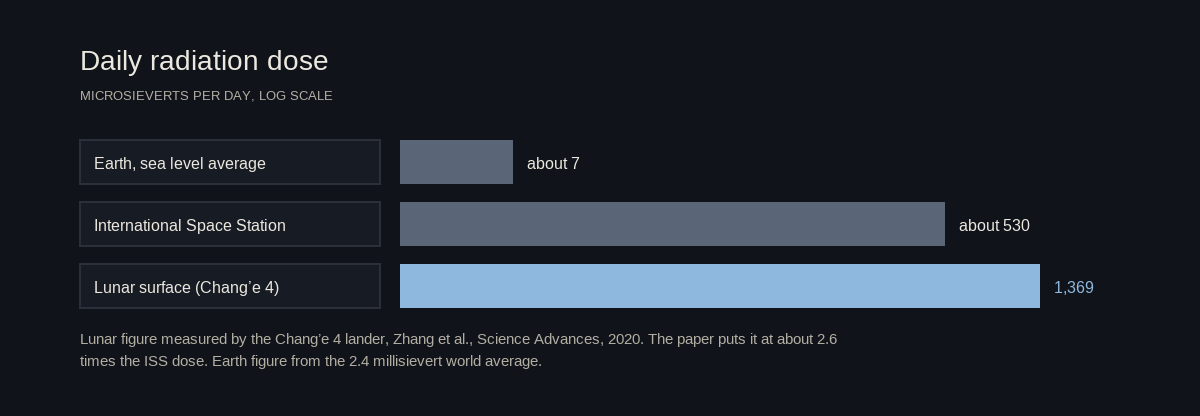
Earth’s thick air and magnetic field block most radiation from space. The Moon has neither. In 2020 a team using a detector on China’s Chang’e 4 lander published the first full measurement from the lunar surface: about 1,369 microsieverts a day. That is about 2.6 times the daily dose inside the International Space Station and roughly 200 times the average at sea level on Earth.
Two kinds of radiation matter. Galactic cosmic rays are a steady drizzle of very fast particles from far outside the solar system. Solar particle events are rare bursts from the Sun that can deliver a large dose in hours. A base needs to handle the drizzle every day and have a safe room for the bursts.
Shelter made of Moon
The cheapest shielding on the Moon is the Moon. A few meters of packed soil over a habitat cuts the dose a great deal. Designs include piling soil on inflatable modules, printing walls from soil with a binder, and tucking habitats into natural shelters.
Those natural shelters exist. In 2024 a team re-reading radar data from the Lunar Reconnaissance Orbiter reported evidence of an underground passage leading off a pit in Mare Tranquillitatis, close to where Apollo 11 landed. Caves like that would offer rock overhead and steadier temperatures.
Dust that bites
Lunar soil is made of rock smashed by billions of years of tiny meteorite strikes. With no wind or water to round the grains, many are sharp and jagged, and sunlight gives them an electric charge that makes them cling. Apollo crews tracked it into their cabins, where it smelled like spent gunpowder. Harrison Schmitt reported a reaction he called lunar hay fever.
Dust scratches visors, clogs seals and wears out joints in suits and machines. Ideas for coping include suits that dock to the outside of a habitat so they never come in, airlocks with dust-removal systems, and paved landing pads so rocket exhaust does not sandblast everything nearby.
Living with it
None of these hazards stops a base. They shape it. Expect homes under soil, short trips outside, and a lot of time spent on cleaning and maintenance. For where a base would sit in the first place, see where to build on the Moon.
Common questions
Is a short Moon visit dangerous?
For a trip of a week or two, the dose is a small addition to an astronaut’s career limit. The bigger worry is a large solar storm during the trip, which is why missions watch the Sun and plan for shelter.
Why not just use thick metal walls?
Metal is heavy to launch, and when cosmic rays hit some heavy materials they can create secondary radiation. Soil, water and plastics rich in hydrogen are good shields, and soil is already there.