Water ice and living off the land
Every kilogram launched from Earth costs a fortune. A base that can make its own water and oxygen changes the math.
Why local supplies matter
Water is heavy. A person needs a few liters a day to drink, and much more for washing, growing food and cooling equipment. Oxygen for breathing adds close to a kilogram per person per day. Shipping all of that from Earth, forever, would cap the size of any base.
Engineers call making supplies on site in-situ resource utilization, or ISRU. On the Moon the two big targets are water ice at the poles and oxygen locked in ordinary soil.
Mining ice
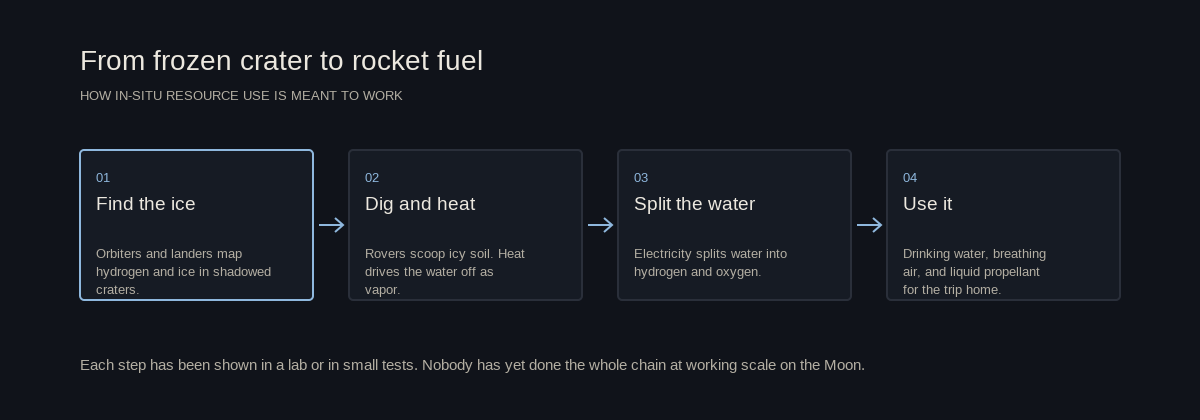
The ice sits in the coldest, darkest places on the Moon, mixed into the soil like frost in frozen dirt. A mining rover would scoop that soil and warm it in a sealed chamber. The water comes off as vapor and freezes again on a cold plate, where it can be collected.
The water can be drunk after cleaning, and electricity can split it into hydrogen and oxygen. Those two gases, chilled into liquids, are the same propellants the Space Shuttle main engines burned. A fuel depot on the Moon could refill landers without hauling propellant up from Earth.
Oxygen from rock
Even without ice, lunar soil is roughly 40 to 45 percent oxygen by mass, bound up in minerals. Several processes can pull it out. One heats the soil with hydrogen to make water. Another melts the soil and runs an electric current through it, a little like the way aluminum is made on Earth. Both work in laboratories. Both need a lot of power.
That is why power and resources go together on every Moon plan. A small nuclear reactor or a large field of solar panels on a lit ridge is the real price of breathing air made from rock.
What has been tested
NASA’s Perseverance rover carried MOXIE, a toaster-sized device that made oxygen from the carbon dioxide in Mars’s air, 16 times between 2021 and 2023. Nothing has yet mined ice on the Moon. The first polar landers and rovers are meant to answer the basic questions: how much ice is there, and how hard is it to dig.
If those answers come back good, ice becomes the reason to build at the pole. If not, oxygen from rock is the backup. For the bigger picture of why energy sits at the root of all of this, see Type 2 Civilization.
Common questions
Could you drink lunar ice?
After cleaning, yes. The ice is mixed with soil and other frozen compounds, so it would be filtered and treated first, the same way a city treats river water.
Why make rocket fuel on the Moon?
Leaving the Moon takes far less energy than leaving Earth, because the Moon’s gravity is about one sixth as strong. Fuel made there could supply trips home and trips deeper into space.