Where to build on the Moon
Real estate on the Moon comes down to two things: steady sunlight and water. The south pole has both, a few kilometers apart.
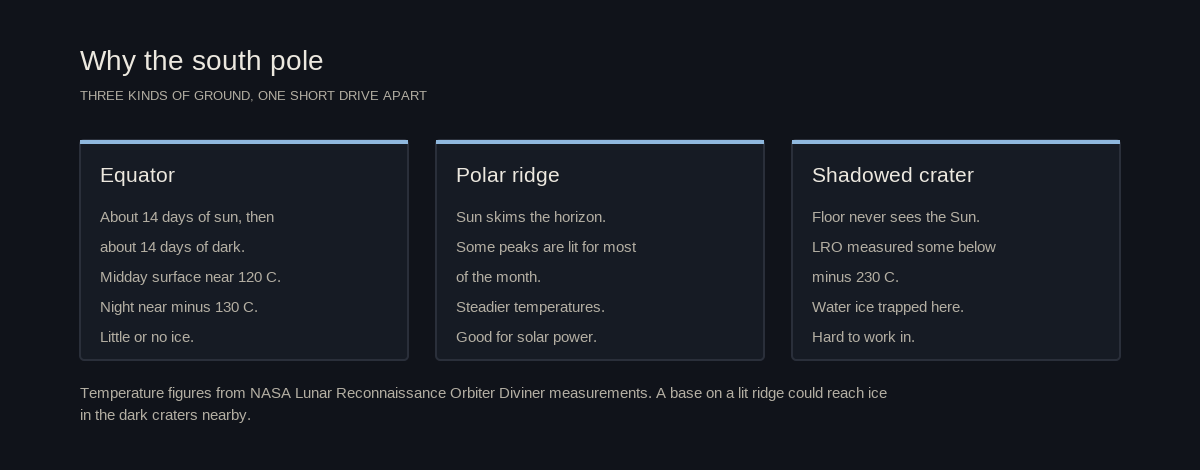
The Moon has a long day and a long night
The Moon turns once for every trip around Earth, so a lunar day lasts about 29.5 Earth days. At the equator that means about two weeks of sunshine followed by about two weeks of darkness. NASA’s Lunar Reconnaissance Orbiter measured midday temperatures above 120 degrees Celsius and night temperatures near minus 130.
Two weeks of dark is the problem. Solar panels stop, batteries have to carry the whole load, and every piece of hardware has to survive a deep freeze. A base at the equator would spend half its life waiting for the Sun.
The poles bend the rules
The Moon’s spin axis is tilted only about 1.5 degrees, compared with Earth’s 23.5. Near the poles the Sun never climbs high. It skims the horizon all month. A tall ridge or crater rim can catch that low light for most of the lunar day, and a few spots near the south pole are lit for the large majority of the year.
The same geometry makes deep craters near the poles stay dark permanently. Their floors have not seen direct sunlight for a very long time, possibly billions of years. The Diviner instrument on the Lunar Reconnaissance Orbiter measured some of them below minus 230 Celsius.
Why the dark matters as much as the light
Those cold traps hold water ice. In 2009 NASA’s LCROSS mission crashed a spent rocket stage into Cabeus crater near the south pole and measured water in the plume that rose out of it. In 2018 a team reading data from India’s Chandrayaan-1 orbiter reported ice exposed at the surface inside shadowed craters at both poles.
Put those together and the pitch for the south pole writes itself. Park solar panels on a lit ridge and drive down into the dark to mine ice. NASA has picked candidate landing regions near the south pole for its first Artemis landings, which it now targets for 2028.
What could still go wrong
Nobody knows yet how much ice is there, how deep it sits, or how evenly it is mixed into the soil. The first landers and rovers at the pole are partly prospectors. The terrain is also rough, the shadows are long and harsh, and the Sun’s low angle makes landing harder to judge by eye.
The rest of this site covers what happens after you land: turning ice into air and fuel and staying safe from radiation and dust.
Common questions
Why not build at the Apollo landing sites?
Apollo landed near the equator on the near side, where landing was easier and the Sun angle could be chosen. Those sites have a two-week night and no known ice, which makes them poor places to stay.
Is any spot on the Moon lit all the time?
No known spot is lit every hour of every year, but some ridges near the south pole are lit for most of it. Planners pair those with batteries or other power for the gaps.